
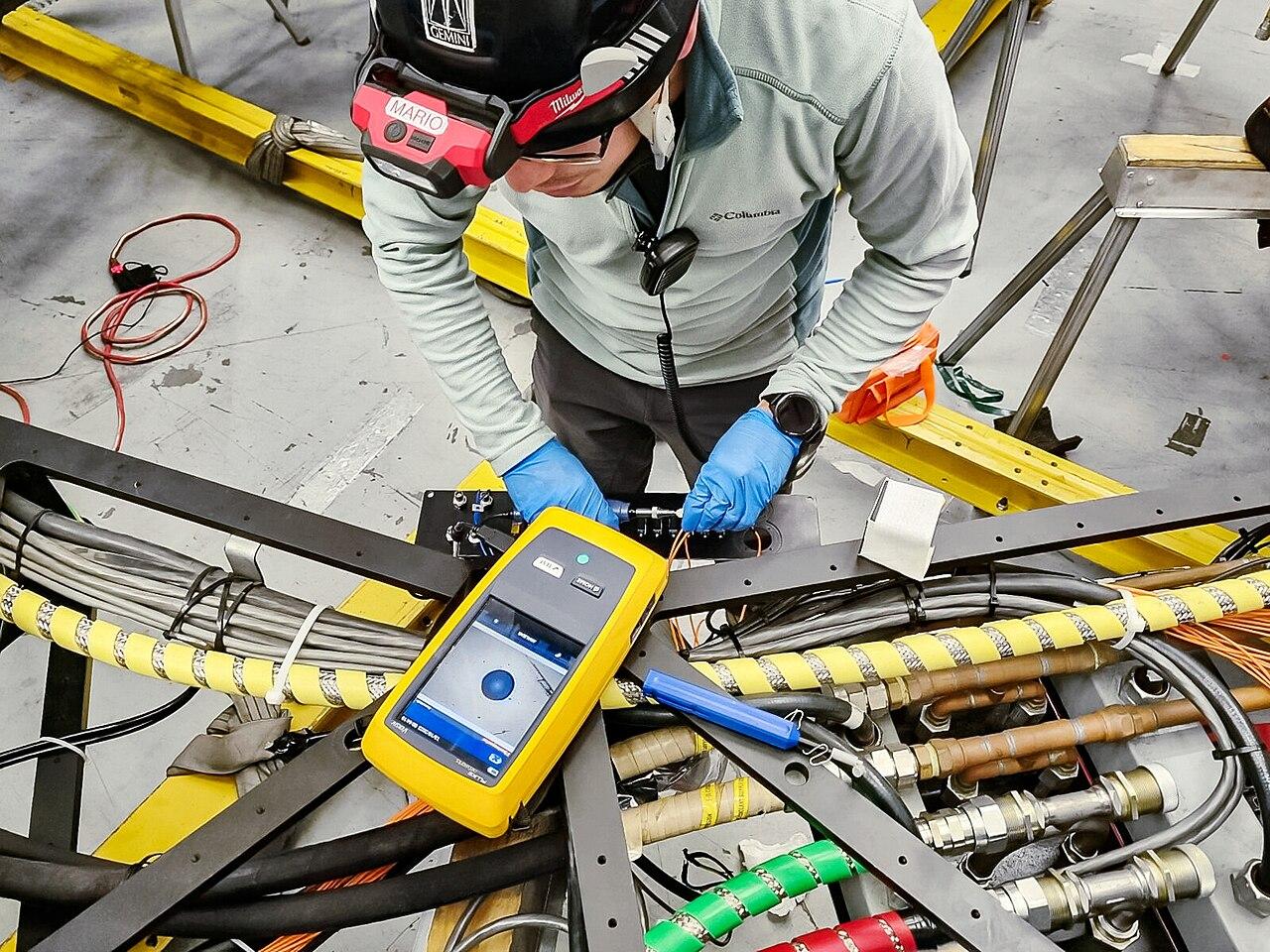
Can your business reuse the fiber already in the building?
Evaluate existing fiber by ownership, identification, condition, application compatibility, and current test evidence before choosing reuse or replacement.
Quick answer: Existing fiber may be reusable, but a working connection or an old test report is not enough to approve every new application. Establish ownership, identify the installed link, inspect its condition, and compare current evidence with the proposed equipment and requirements. Price corrective work and testing before deciding whether reuse is the better project choice.
A new tenant opens a telecom cabinet and finds fiber already terminated in a panel. That is a useful discovery, not a completed design. The cable may connect the right rooms, belong to another party, or have records that describe a configuration no longer in place.
The sensible response is an assessment rather than an automatic replacement order or an assumption that the existing link is ready. This guide follows the evidence needed for that decision. The objective is to preserve useful infrastructure while making the limits of reuse clear to the business that will depend on it.
Establish who owns the link and what it serves
Start with the building owner, previous installation records, and the current network administrator. Identify whether the fiber is customer-owned, shared building infrastructure, or part of a provider service. Do not disconnect or repurpose a strand merely because it appears unused at one panel.
Locate both endpoints and document any intermediate termination or splice information available. If labels are incomplete, have the responsible technical team plan an authorized identification process. An unexplained cable should remain unexplained in the project record until the evidence resolves it; giving it a convenient name does not establish its route.
Confirm who can approve testing and any required service interruption. In a hypothetical multi-tenant building, a cable entering your suite may pass through shared equipment space. The assessment needs permission and access at the relevant locations, not only a technician standing at the tenant's end. These ownership and access questions can determine whether reuse is practical before performance testing begins.
Reconstruct the installed configuration
Collect the cable identification, fiber type, route length evidence, connector arrangement, panels, patch cords, and existing equipment details. Mark the confidence of each item. A manufacturer marking, a trustworthy installation record, and an undocumented verbal recollection are not equivalent evidence.
Compare available drawings with the physical installation. Look for changes in panel numbering, added patching, relocated equipment, or undocumented intermediate connections. Record what can be observed without disturbing the operating network and what requires a planned inspection. Do not make the investigation itself an unapproved outage.
Keep the assessment tied to a defined link boundary. A record for the permanent cabling may not include the patch cords now connecting equipment. Fluke Networks' fiber troubleshooting paper distinguishes permanent-link and channel testing and discusses patch cords as potential sources of problems. That distinction helps explain why an old passing cable result may not describe the complete path currently in use.
Compare the proposed application with the actual fiber
Identify the new equipment and optical interface before declaring the existing cable suitable. Have the designer check the documented fiber type, length, connection arrangement, and applicable performance requirements. A link that supports today's equipment does not automatically establish support for a different optical application.
Corning's system-testing tutorial separates passive-link performance from the active electronics and intended application. Use that separation to assign the review. The cabling assessment should address the physical link, while the equipment owner confirms the selected devices and optics.
Where a manufacturer supplies a compatibility resource, consult it for the actual products. Cisco's optics-to-device matrix is one example. Do not infer compatibility from a connector fitting into a port or from an optic that worked in a different switch. Our fiber type comparison guide helps organize the broader application questions before a specific interface is approved.
Inspect condition without assuming the cable itself is the fault
Ask qualified personnel to inspect accessible terminations, patching, and cable management under an approved work plan. The assessment should look for evidence that can be investigated, rather than treating every untidy cabinet as proof that the permanent cable must be replaced.
Fluke's troubleshooting guidance identifies several possible contributors to a poor link, including contamination, termination problems, polarity, bends, and channel design. These possibilities matter because corrective work may concern a particular component or configuration. The investigation should determine the issue instead of starting with a predetermined replacement scope.
For a hypothetical office upgrade, a problem introduced by an equipment patch cord would call for a different response from damage in an inaccessible permanent route. Record the findings and proposed correction separately. If a component is changed, identify it in the final configuration so later test records can be understood. An assessment loses much of its value if the evidence and resulting work are not connected.
Decide whether the old test evidence is still usable
Review the date, identifiers, boundaries, method, settings, and limits in the available reports. Ask whether the record describes the current installed path and the proposed application. If the link has been altered or the intended use has changed, have the testing team explain what additional evidence is required.
The review should answer a few concrete questions:
- Can each result be matched to the physical strand and both endpoints?
- Does the report identify the test method and acceptance limit?
- Are the required conditions and results present, including any agreed spare strands?
- Have changes or repairs occurred since the test?
- What remains to be measured before the new use can be accepted?
A missing report does not by itself prove the fiber is defective. It does mean the project cannot rely on that missing evidence. Price an appropriate assessment and testing scope rather than treating uncertainty as either a guaranteed pass or an automatic reason to discard the installation.
Compare complete reuse and replacement scopes
Build two honest options when the evidence supports a comparison. The reuse option may include identification, cleaning or repair, new patching, testing, documentation, and equipment changes. The replacement option may include pathway work, new cable and terminations, restoration, cutover, and the same acceptance requirements.
Compare the work windows and remaining uncertainties as well as cost. Reuse may preserve a useful route, while replacement may address a confirmed limitation or create a clearer documented installation. Neither outcome should be chosen solely because one avoids buying cable or because the old cable looks dated.
Ask for a decision record that explains the result. For example, a hypothetical building link might be accepted for a defined application after specific corrective work and current tests. That is a bounded conclusion. It should not be rewritten as a general claim that all existing fiber in the property is approved for future upgrades.
Accept the reused link as a documented project result
Treat reuse as an installation deliverable with its own final state. Preserve the confirmed identifiers, route information, components retained, components replaced, and accepted test evidence. List any limitations that remain relevant to future work. The business should know exactly what was assessed and what was outside the investigation.
Use the fiber acceptance guide to organize passive-link evidence, then complete the agreed operational tests with the selected equipment. Record the configuration used for those tests. If the application fails despite acceptable cabling results, investigate the appropriate equipment and configuration boundary instead of declaring the entire assessment invalid without evidence.
Keep the records where the maintaining team can retrieve them. When the next upgrade arrives, the business should not have to repeat the original detective work. Update the documentation after subsequent repairs or patching changes so today's reuse decision remains understandable rather than becoming another unverified story about the cabinet.
The takeaway
Reuse should be an evidence-based project choice. Confirm ownership and endpoints, reconstruct the installed configuration, and evaluate it against the proposed application. Inspect and test the relevant boundaries so a correctable component issue is not confused with a reason to replace the entire route.
The most useful outcome is specific: this identified link, in this documented configuration, meets these agreed requirements after this work. That conclusion gives the business a usable asset and a clear starting point for future changes without promising performance the assessment did not establish.
Assess the fiber you already have
Share available drawings, equipment details, and test records with BlueHouse Telecom to discuss fiber installation and upgrade planning nationwide.
FAQ
Does old fiber always need replacement? No. Age alone does not settle suitability. Identify the actual installation, condition, ownership, and application requirements, then obtain the evidence needed to evaluate reuse.
Can we trust a previous passing test? Review what it tested and whether it still describes the current link and intended use. Changed patching, repairs, missing identifiers, or a different application may require additional assessment.
Can the cable be suitable while the connection still fails? Yes. Equipment compatibility, configuration, patch cords, and other parts of the complete path also need investigation. Keep passive-cabling and operational tests distinct.
What should a reuse assessment deliver? Request an identified scope, findings, required corrective work, accepted test records, and a statement of the application evaluated. Keep exclusions and unresolved items visible rather than assuming the whole building was assessed.