
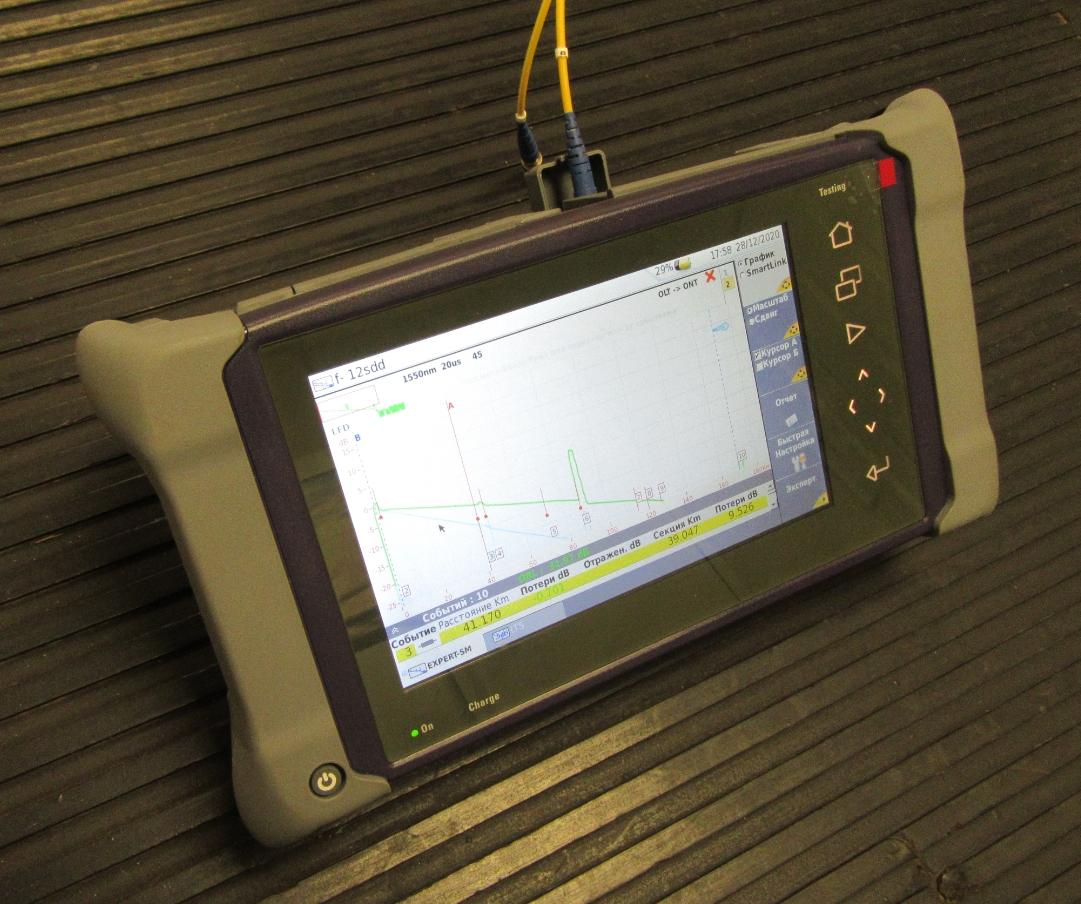
What a business owner should ask about an OTDR trace
Use OTDR reports to understand fiber events, exceptions, and repair evidence without mistaking a trace for complete acceptance.
Quick answer: Ask the testing team to connect each OTDR trace to an identified fiber, explain unexpected events, and show how the result fits the agreed acceptance plan. A useful review covers endpoints, test settings, unresolved limitations, and any corrective work. Keep the separate insertion-loss evidence required by the project.
A trace with a green status box can still leave an owner unable to answer a basic question: which installed fiber does this report describe? The graph becomes valuable when its events can be connected to known panels, joints, and the documented cable route. Without that connection, it is difficult to use during either acceptance or a later outage.
The owner does not need to become an OTDR operator. The goal is to ask precise questions, obtain a defensible interpretation, and avoid approving work on the strength of an unexplained picture. These questions also help a facilities manager distinguish an installation problem from a report that needs better context.
Establish the question the trace is meant to answer
Start by identifying the purpose of the test. The project may require a baseline for a new cable, evidence about particular splices, or investigation of an existing fault. Those objectives should be stated before the reviewer begins debating every small feature on the graph.
AFL describes an OTDR as analyzing returned backscatter and reflections to locate and characterize events. That makes it useful for understanding where something happens along a fiber. It does not mean that every business question can be settled from one automated trace.
Ask the technical team what conclusion the submitted test supports and what it does not establish. For example, a diagnostic trace may help locate a suspected problem while further testing remains necessary before the link is accepted for its intended application.
Use the fiber testing acceptance guide to keep the full evidence package in view. The trace should serve a defined role in that package, rather than becoming a substitute for other required records simply because it looks more detailed.
Match the graph to the physical fiber
Require the cable identifier, strand identifier, near endpoint, far endpoint, and test direction. Those details should agree with the installed labels and the final drawings. A report titled “fiber 1” is ambiguous when several cables each contain a first strand.
Have the testing team identify where the installed link begins and ends on the trace. Launch and receive fibers may be part of the test arrangement; they should not be confused with cable that the business purchased and installed between rooms.
For a hypothetical warehouse, an intermediate enclosure might appear in the route documentation but be missing from the report explanation. Ask whether the event is present, unresolved, or outside the tested path. Do not fill the gap by assuming the nearest visible feature must be that enclosure.
Reconcile mislabeled records while the site and instrument files are available. A correct measurement attached to the wrong identifier is still a poor maintenance record. The business needs confidence that a future technician can find the same strand without tracing the entire building again.
Ask which events were expected
The technical reviewer should compare the trace with the actual construction. Known connections and splices provide context for the event list. An unexpected feature is a reason for investigation, while an absent expected feature may require an explanation of the measurement's limits.
Use a short discussion checklist rather than asking for an improvised diagnosis from the graph alone:
- Which listed events correspond to documented connections or splices?
- Which events need further investigation or a corrected label?
- Were both end connections assessed under the intended setup?
- Are any closely spaced features unresolved in this measurement?
- What conclusion and next action apply to each exception?
AFL explains that multiple reflections can create ghost events. That is one reason an automated event label should be interpreted by someone competent with the instrument and link. A buyer should not order excavation or replace a cable based solely on a suspicious icon.
Likewise, an unexplained graph should not be dismissed as harmless without evidence. Ask for the test team's reasoning, supporting checks, and final disposition. A concise written explanation is more useful than a verbal assurance that the tester sometimes behaves that way.
Separate distance along fiber from a repair location
An OTDR distance can help narrow an investigation, but it is not a survey coordinate. The FOA's OTDR reference explains that distance calculations depend on fiber properties and that fiber length is not simply identical to cable sheath length. The route can also include stored slack and changes in direction.
Ask how the reported event distance will be related to the installed route. Drawings, enclosure locations, known reference points, and cable records should support that interpretation. A straight line measured across a floor plan is not automatically the same path traveled by the cable.
In a hypothetical campus fault investigation, a reported distance near an outside enclosure would make that enclosure a candidate for inspection. It would not by itself authorize digging at a point the same distance from the building entrance. Site verification and the applicable work controls still matter.
Keep the distinction clear in the repair request. Describe the suspected portion of the route and the evidence behind it, along with uncertainty that remains. That gives the repair team a useful starting point without presenting an estimate as a proven physical location.
Review direction and setup before interpreting loss
The same joint can produce different apparent event-loss readings when tested from opposite directions because of backscatter characteristics. FOA discusses this limitation and the use of directional analysis. A surprising reading should therefore prompt review of the required test method, not an immediate assumption that the fiber creates optical power.
Ask whether the contract requires testing in both directions and how the paired results were analyzed. The answer should identify the same physical events and preserve the underlying records. Do not average unrelated values merely because the filenames appear similar.
Instrument settings also belong in the explanation. The testing team should confirm that the selected wavelengths, pulse widths, range, and other relevant parameters suit the link and purpose. The owner should not guess at those settings or copy a configuration from a much longer cable.
If a setup limitation prevents a required conclusion, request a specific next step. That could involve another supported measurement arrangement or a different test selected by the responsible technical team. “The machine says pass” does not resolve a question the measurement could not answer.
Keep total-loss acceptance as a separate decision
An OTDR estimates loss from its trace, while an insertion-loss test uses a source and power meter across the link. FOA distinguishes these approaches. Their results should not be treated as interchangeable simply because both reports display values in decibels.
Check the acceptance plan to see which evidence is required for the intended cabling and application. If the project calls for insertion-loss results, retain that requirement even when the OTDR package is extensive. A stack of traces does not automatically answer the same question.
When the reports appear inconsistent, ask the team to reconcile boundaries, setup, wavelengths, identifiers, and the methods used. Avoid choosing the more favorable number and filing away the other report. The difference may contain information the designer needs before accepting the link.
The single-mode versus multimode guide adds context when a project includes several fiber types or existing infrastructure. Keep each result associated with the actual material and application, rather than treating all fiber in the building as one interchangeable system.
Turn exceptions into a useful closeout record
For each unresolved event or reporting issue, record the observation, proposed investigation, responsible contact, and required evidence for closure. Keep the description specific enough that another reviewer can understand it without replaying the original meeting.
If physical work is performed, retain the before-and-after records and describe what changed. A corrected splice, a cleaned connection, a revised setup, and a corrected filename are different actions. The closeout should distinguish them so later maintenance teams do not infer repairs that never occurred.
Request the usable original test files along with the readable report format agreed for the project. Confirm that the business can access the files and associate them with the current drawings. An export locked in a former employee's mailbox is not a dependable baseline.
Close the review with a plain statement of accepted scope and any remaining limitations. The result should tell the owner which fibers are ready for the intended next step, which need follow-up, and where the evidence can be found. That is more valuable than a graph collection with no decision attached.
The takeaway
An OTDR trace is most useful when it answers a specific question about a known fiber. Match it to the route and endpoints, ask for an explanation of unexpected events, and require the testing team to account for setup and interpretation limits.
Keep the trace connected to the full acceptance package and the final maintenance records. The owner should leave the review with a clear disposition for each exception and evidence that another qualified team can use later, rather than relying on an unexplained pass indicator.
Plan fiber testing and closeout together
Discuss the route, acceptance requirements, and maintenance records with BlueHouse Telecom's fiber installation service for projects across the United States.
FAQ
Does every mark on an OTDR trace represent a physical defect? No. Expected connections, splices, and measurement artifacts can appear in the record. A qualified reviewer should relate the trace to the known construction and investigate unexplained features.
Can an OTDR distance identify an exact digging location? It can guide investigation, but it must be reconciled with route records, slack, fiber properties, and field conditions. Do not treat a displayed distance as an excavation authorization.
Does an OTDR pass replace the required insertion-loss test? Follow the agreed acceptance plan. The methods answer different questions, and an OTDR report should not silently replace another specified measurement.
What should be kept after a repair? Preserve the original observation, the action taken, and the resulting test files and reports. Update the affected identifiers or drawings so future troubleshooting starts from the actual final condition.