
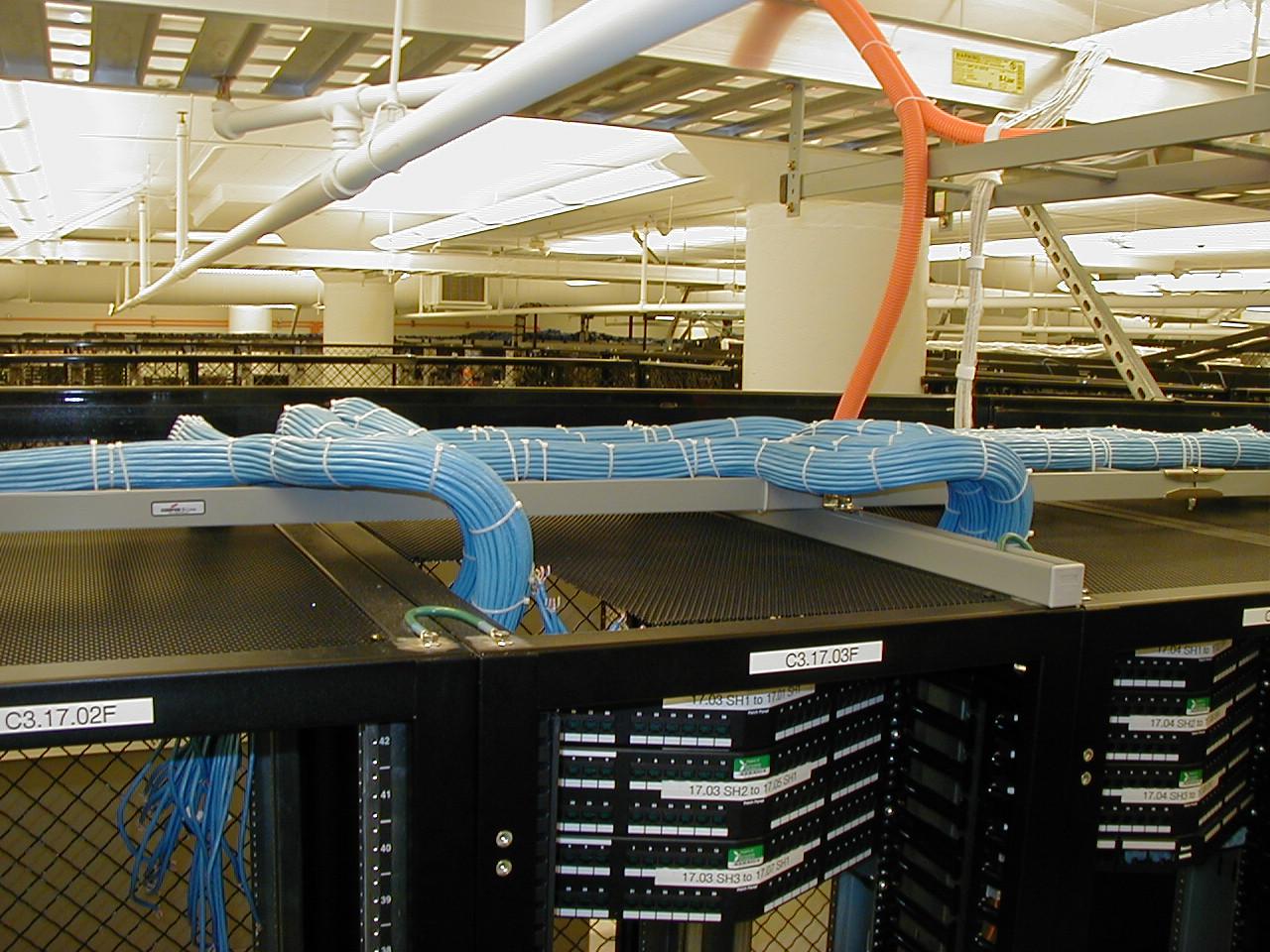
A pathway survey can change your fiber installation budget
Inspect the actual fiber route, access points, obstructions, and restoration work before treating a drawing as an installation plan.
Quick answer: Survey the route the fiber will actually use, including entries, turns, access points, and the final approach to each enclosure. Record what was inspected and what remains concealed or unverified. Price the pathway work, access restrictions, and restoration alongside the cable installation so a short distance does not disguise a difficult job.
Two rooms can be close on a floor plan and expensive to connect. The available route may cross a tenant boundary, pass through a congested ceiling, or require work in a space that can only be accessed outside operating hours.
A pathway survey turns those conditions into decisions before they become installation delays. Its purpose is to establish a usable route and identify unresolved sections. Measuring the distance alone is not enough, especially when the business expects a firm scope and an installation date.
Trace the route from the actual endpoints
Start at the proposed termination hardware and follow the cable path all the way to the other endpoint. Include the vertical approach to the rack, transitions between spaces, and the way the cable enters its enclosure. A line drawn between two rooms can omit much of that physical path.
Confirm endpoint positions with the people responsible for the equipment and building layout. If a rack may still move, show that as a design dependency. Do not treat a preliminary furniture or equipment drawing as a final measurement reference without checking its status.
The FOA's installation guidance calls for assessing the route and likely obstacles before installation. Apply that principle to the entire path, not only the accessible corridor between the rooms. The most consequential restriction may be the last turn into an enclosure or an inaccessible section above an occupied area.
Use the fiber installation planning guide to establish which endpoints belong to the project. Where a carrier delivery point is involved, agree on the inside extension before assuming that the internet installation includes it.
Mark inspected and unverified sections differently
A survey should be honest about visibility. Record which sections were observed directly, which were supported by current building records, and which remain unverified. Those are different levels of confidence and should not appear as the same solid line on an approval drawing.
If access is unavailable, identify what permission or preparation is needed to inspect the section. A locked room, inaccessible ceiling, or active work area may require a return visit. Show that next step and its effect on pricing or scheduling rather than burying it in a general site-conditions disclaimer.
Existing pathway labels are useful clues, but they do not establish that the pathway is continuous, clear, or suitable for the proposed assembly. Have the installer determine the appropriate verification method under the site's access and safety procedures. The business owner should expect evidence of the conclusion without directing an improvised inspection.
For a hypothetical office renovation, a drawing may show conduit between two closets while the actual endpoint is behind new cabinetry. That discrepancy can change the usable route and the installation sequence. Discovering it during the survey lets the project resolve it before cable and hardware are committed.
Check the pathway against the selected cable
Route suitability depends on what will be installed. A preterminated assembly, a larger cable, or a different cable construction can introduce requirements that were not present in an earlier installation. The existence of an old cable in the pathway does not prove that the proposed product can be installed there correctly.
Ask the designer and installer to compare the route with the manufacturer's installation limits and approved method. The FOA identifies pulling tension, bend radius, and crush limits as cable-specific concerns. This is a technical review of the product and path, not a universal rule based only on fiber count.
Include the temporary installation arrangement. The cable may need space for its reel, handling equipment, and intermediate access. A finished route can look acceptable while the business has not provided the space needed to install the cable without unsuitable handling.
If the product changes after the survey, revisit the affected assumptions. A substitution that appears equivalent in optical performance may differ in dimensions, construction, connector protection, or handling requirements. The approved route and the approved cable should remain a matched design.
Identify who controls each space
List the spaces the route enters and the parties who control access. These may include the business, property management, neighboring tenants, or a building operations team. Ask who can authorize the work and whether the installation requires an escort or a particular time window.
Permissions should describe the proposed activity sufficiently for the site. Access to inspect a ceiling is not automatically permission to install new supports or make a penetration. Coordinate the required reviews with the responsible building professionals and keep the scope of each approval clear.
Lumen's readiness guidance, for example, identifies site access and inside wiring among the conditions relevant to service delivery. The broader lesson is to schedule the interior work and permissions as real prerequisites. A carrier appointment does not resolve every building-access issue on the customer's behalf.
For a hypothetical multi-tenant building, the preferred path may cross a common communications room before entering the business suite. Confirm the route, access arrangements, and responsibility for the intervening connection. Do not let the installer arrive expecting a key that nobody on the project is authorized to provide.
Include the work needed to leave the building complete
Pathway work can create tasks beyond placing cable. The scope may need supports, access arrangements, approved penetrations, protection, cleanup, and restoration of affected finishes. Have the responsible professionals determine what applies and identify who performs each part.
A useful survey record includes:
- The proposed route and exact termination locations.
- The inspected sections and remaining access or verification gaps.
- Cable and assembly assumptions used to judge the pathway.
- Required building permissions, work windows, and escorts.
- Pathway preparation and the party responsible for completing it.
- Restoration and documentation expected at the end of the work.
Keep required building reviews separate from optical acceptance. A passing fiber test does not establish that every physical opening or support was completed appropriately. Conversely, a neat finished ceiling does not establish that the cable meets the project's optical requirements.
Ask for exclusions that describe actual boundaries. If restoration is outside the fiber proposal, name the responsible party and place its work on the schedule. An exclusion without an assigned next step is still an unfinished part of the overall project.
Compare alternative routes by the complete effort
The shortest route may not be the simplest route. Compare access requirements, preparation, installation method, maintenance access, and restoration for each credible option. The decision should reflect the full sequence rather than the number of feet of cable alone.
A hypothetical warehouse could have a shorter path over active equipment and a longer path along an accessible perimeter. The first may require an operating shutdown; the second may need more cable and supports. There is no universal winner. The survey should give the business enough information to weigh those consequences.
Ask the installer to identify which assumptions drive the comparison. If one route is priced on the assumption of uninterrupted access, state that. If another depends on existing pathway availability, establish how it will be verified before the project commits to it.
Do not approve a vague alternate route to solve every future obstruction. Define who can approve a deviation and what must be rechecked, including cable length, handling limits, endpoint approach, and building permissions. That keeps an on-site discovery from quietly changing the project into something the business never reviewed.
Use route findings to control the installation sequence
Turn the survey's open items into a short readiness list. Each item needs an owner, a required result, and a point in the schedule when it must be complete. Work that depends on an unverified section should remain conditional until that section is resolved.
Confirm the route again when other construction has occurred between survey and installation. A newly installed duct, partition, or storage arrangement can change access. The appropriate recheck depends on the site, but an old survey should not be treated as proof that nothing has changed.
During installation, record approved deviations and retain the final route information. Link it to cable identifiers and termination records so future work can locate the connection. The fiber testing acceptance guide covers the complementary optical evidence needed at closeout.
Finish with a walkthrough of the agreed physical scope. Confirm that preparation, installation, labeling, and restoration are complete or explicitly listed as outstanding. A useful survey ultimately produces a route the business can understand and maintain, not merely a document used to justify the original price.
The takeaway
A fiber pathway survey establishes whether the proposed cable can reach its endpoints through a practical, approved route. It also exposes the access, preparation, and restoration work that a simple distance estimate misses.
Keep inspected facts separate from assumptions and compare route options by their complete effect on the project. When unresolved sections have named next steps, the business can approve a realistic scope and schedule instead of discovering the missing work during installation.
Review the route before ordering fiber
BlueHouse Telecom helps businesses scope fiber installation projects nationwide, including pathway review, endpoint coordination, and acceptance requirements.
FAQ
Is a floor plan enough to price a fiber route? It is a useful starting point, but it may not show current access, obstructions, or the final approach to equipment. Confirm the actual route and clearly identify any sections that remain unverified.
Does an existing conduit prove the new cable will fit? No. The installer must evaluate the actual pathway and proposed cable or assembly using the applicable product requirements and site conditions. Existing use does not automatically establish suitability for a different installation.
Should the shortest route always be selected? Compare the total work, including access windows, preparation, installation constraints, maintenance, and restoration. A longer accessible route can present a different overall cost and schedule from a short restricted one.
What should happen when the planned route is blocked? Pause the affected work and use the agreed deviation process. Recheck the alternative's permissions, product requirements, length, and scope before proceeding, then update the final route records.