
Two fiber links do not automatically provide route diversity
Find shared conduits, entrances, equipment, and power before treating a second fiber link as an independent recovery path.
Quick answer: Judge fiber diversity by the failures each path can survive, not by the number of cables or carrier logos. Trace both routes through ducts, entrances, equipment, and power, and mark every shared dependency. Then test the approved switching behavior separately from the physical route review.
A second fiber link can protect against a failed optical module while doing nothing about the construction crew digging through the shared entrance conduit. Both purchases can be reasonable. The problem begins when a proposal describes the narrower protection as complete independence.
Before paying for another route, decide which interruption the business wants to withstand. A damaged campus cable, an unavailable equipment room, and a regional carrier failure require different evidence. This review gives procurement and network staff a way to compare those outcomes without treating every second connection as the same improvement.
Name the failure you are trying to survive
Start with a short scenario, written in operational terms. For example, a hypothetical distribution office needs its shipping application to remain available if the fiber serving the main building entrance is cut. That requirement points directly to the entrance and the route beyond it. It does not, by itself, require a second data center or an entirely different application architecture.
Write down what must continue, for how long, and at what reduced capacity. A secondary path that supports shipping transactions but cannot support every employee download may still meet the requirement. Conversely, a connection that restores ordinary browsing but cannot reach the shipping application's authorized endpoint may not.
Avoid an absolute statement such as no common points of failure unless the design and its boundaries justify it. Most organizations can identify a smaller, defensible claim: separate campus trenches between two defined rooms, for example. A specific boundary makes engineering review and price comparison much easier than an undefined promise of resilience.
Follow the physical route beyond the patch panel
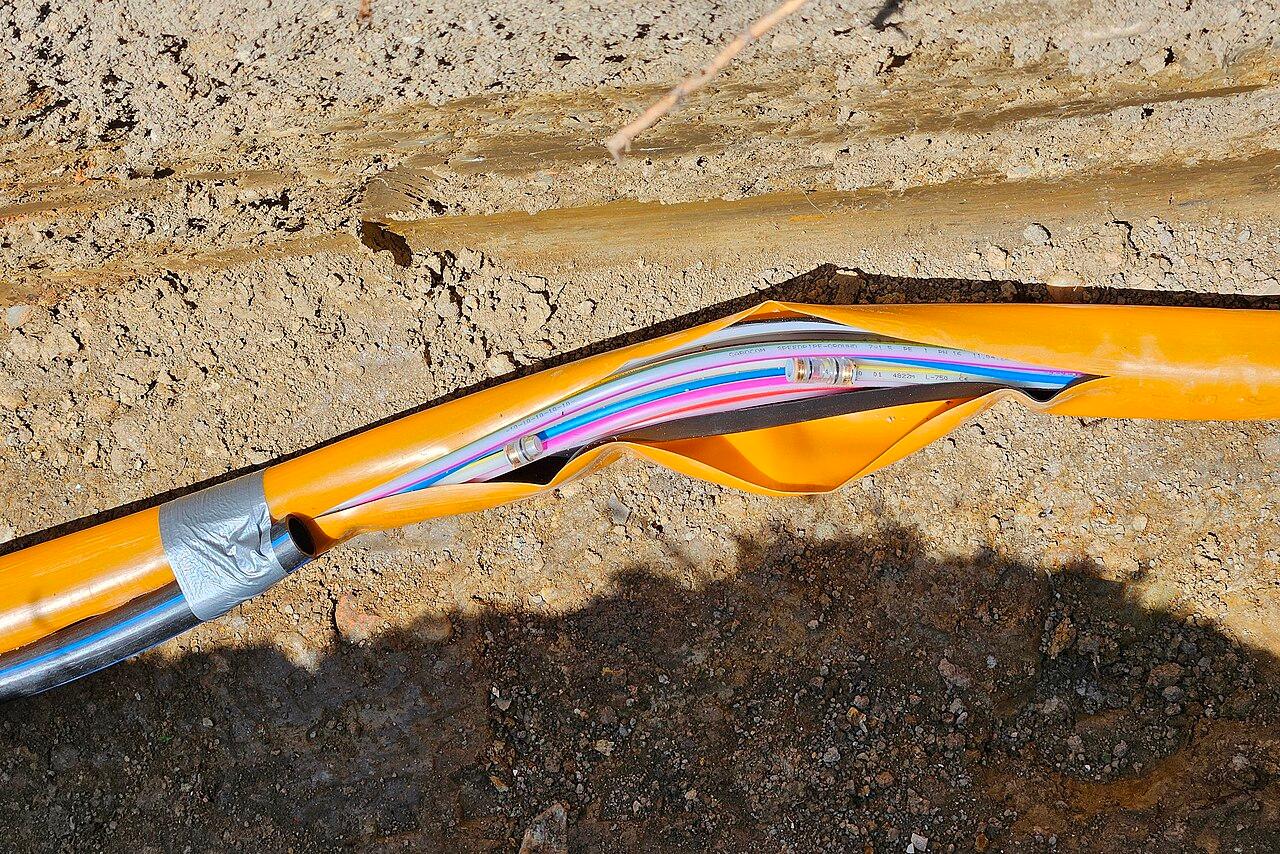
Two cords leaving different panel ports may enter the same cable. Two cables may occupy one tray, and two trays may converge at a single wall penetration. Begin at the actual endpoint and follow each path far enough to understand the failure scenario you chose. Treat an undocumented stretch as unknown rather than independent.
On a private property, useful evidence can include current route drawings, photographs of accessible transitions, enclosure identifiers, and installation records. Coordinate access with the property owner. A drawing does not authorize opening a restricted chamber, disturbing a firestop, or tracing a live cable by disconnecting it.
Carrier routes require a different conversation. Ask what route information the provider can disclose and what written diversity commitment is available for the selected service. Some detailed maps may require controlled handling. A commercial network coverage map is not evidence that two particular ordered circuits use different last-mile facilities.
Separate provider diversity from route diversity
Lumen's current resiliency explanation explicitly warns that circuits sold by different providers can share conduit or underlying capacity. That is a useful buying distinction, not proof that every pair of carriers shares a route. The question must be answered for the endpoints and service orders under consideration. Lumen's explanation also distinguishes diverse paths from protection that switches traffic between them.
When comparing proposals, ask whether the second provider owns or leases the relevant access facilities, and whether the proposed route overlaps the first service. The answer may change by address. A national account agreement does not make the physical arrangement at every branch identical.
Do not transfer a published wavelength protection feature, switching time, or availability commitment to a basic internet order. Those promises belong to particular products and agreements. The business internet failover guide addresses the separate task of selecting and testing how business traffic uses an alternate internet connection.
Look for shared dependencies inside the building
An independent outside route can still terminate on the same switch, firewall, power supply, or electrical circuit. Decide which of those shared elements matters to the chosen failure scenario. Replacing one shared component with two may create new configuration and maintenance requirements, so it should be an explicit design choice rather than a reflex.
Use this review list during the route walkthrough:
- Identify both cable paths, their entrance points, and any shared enclosure or penetration.
- Record the endpoint ports and active equipment that each connection requires.
- Confirm which power supplies, electrical circuits, and backup systems serve those devices.
- Identify any shared upstream switch, router, application gateway, or provider access segment.
- Mark uncertain route sections and request the evidence needed to resolve them.
- State the exact failure scenarios the completed design will and will not address.
A hypothetical office might accept a shared firewall because its immediate concern is excavation damage outside. Another organization may require equipment separation because firewall maintenance is the frequent interruption. Both decisions can be rational when the remaining dependency is visible and approved.
Compare feasible alternatives by outcome
A completely separate underground path may be expensive or unavailable. Price the practical alternatives against the stated scenario. These might include a different building entry, a revised campus path, a second provider with documented access separation, or an appropriate wireless backup. Each option has different capacity, power, and operating constraints.
Ask bidders to identify the degree of separation their proposal actually provides. An alternate trench that rejoins the original duct before reaching the building should be described that way. Its value depends on where the expected hazard is located; it is neither automatically useless nor fully independent.
Include the work needed to operate the alternate path. A spare fiber pair may require manual patching, compatible optics, and someone authorized to make the change. An automatically selected connection needs the appropriate network design and testing. Price comparison should include those tasks alongside construction, recurring service, and maintenance responsibilities.
Test switching without confusing it with route proof
A successful failover exercise proves behavior under the conditions tested. It does not prove that the cables are physically separate. Disabling one interface while the other carries traffic can demonstrate a configured response, yet both outside cables may still share the same vulnerable conduit.
Have the network owner define a controlled test with a clear start, stop, and recovery sequence. Choose representative applications and observe reconnect behavior, authentication, and any change in available capacity. Existing sessions may behave differently from newly opened ones, so testing only a fresh browser window leaves an important question unanswered.
Keep the physical evidence and functional results in separate parts of the acceptance package. A failed switching test calls for a configuration or application investigation; a shared duct calls for a route or risk decision. This separation prevents teams from repeatedly adjusting network settings when the unresolved concern is actually physical construction.
Keep the claim accurate after changes
Diversity is a property of the current arrangement. A later repair, provider migration, equipment consolidation, or building renovation can change it. Add route-sensitive dependencies to change review so that a convenient replacement path does not quietly erase the reason the second connection was purchased.
Maintain a concise diagram showing the protected boundary and the known common elements. Include the date, supporting records, service identifiers, and any provider qualification. Someone investigating an outage should be able to tell whether the diagram describes an observed installation, a contractual commitment, or an unverified planning assumption.
Revisit unresolved exceptions during renewals and major site changes. A previously unavailable entrance may become feasible during renovation, while a documented independent path may be rerouted during street work. The goal is not to redraw the network every month. It is to reassess the diversity claim whenever a relevant dependency changes.
For a nationwide portfolio, use the same evidence categories at each location but preserve the local answer. One site may have verified physical separation; another may have only provider separation; a third may use wireless backup for limited functions. Reporting those distinctions is more useful than labeling all three sites redundant.
The takeaway
A second fiber link earns its value by surviving a defined failure. Establish that failure first, trace the dependencies that could defeat the second path, and buy the separation that changes the business outcome. Unknown route sections should remain visible until someone supplies credible evidence.
Physical diversity and traffic recovery need separate acceptance work. Keep both results with the final diagram so future changes preserve the protection you paid for. For the broader installation scope, the fiber installation guide helps separate cable construction from service and equipment responsibilities.
Review the routes before ordering
BlueHouse Telecom helps businesses nationwide scope fiber installation projects, including the site information and dependency questions needed to evaluate a second path.
FAQ
Are two fiber strands in the same cable diverse? They can provide separate optical connections, but they share the cable and its physical route. A cut through that cable can affect both. Describe the protection according to the specific failure being addressed.
Does choosing two carriers guarantee independent routes? No. Separate providers may use shared access facilities or conduit. Request address-specific route evidence and any applicable written diversity commitment for the services being ordered.
Can a failover test confirm physical diversity? It confirms how the network behaves during the tested interruption. Physical separation requires route evidence. Keep those two findings separate in the acceptance record.
Is a partially shared route always a bad purchase? No. It may reduce exposure to a particular hazard while leaving another dependency unchanged. State the shared section clearly and compare the improvement with its cost and operating requirements.