

Network Redundancy: Keeping Your Business Online When a Circuit Fails
What real network redundancy looks like, why a second line from the same provider is not enough, and how to size backup connectivity to what an outage actually costs you.
Elias Thorne
April 7, 2026
Ask anyone who has lived through it. The internet goes down at 9:15 on a Tuesday, the phones die because they ride the same line, and within twenty minutes you have a lobby full of people and a sales team that cannot process a single order. Nobody thinks about redundancy until the first outage. The companies that recover fastest are the ones that planned for the failure before it happened.
Redundancy is not one product. It is a design choice about how many ways your traffic can reach the outside world, and how quickly it reroutes when one of them breaks. Let us walk through what actually holds up under pressure.
Two Lines Are Not Redundant If They Share a Path
Here is the trap people fall into. They order a second internet circuit from the same provider, feel covered, and then both go dark at once when a backhoe cuts the fiber two blocks away. If both circuits ride the same physical path or terminate in the same provider hub, you do not have redundancy. You have two bills.
Real diversity means a second connection over a different medium and ideally a different carrier. Fiber as your primary, then cable, fixed wireless, or cellular as the backup. Different last mile, different network, different failure points. When you ask a provider whether your two circuits are diverse, push for a specific answer about the physical path, not a reassuring shrug.
Automatic Beats Manual Every Time
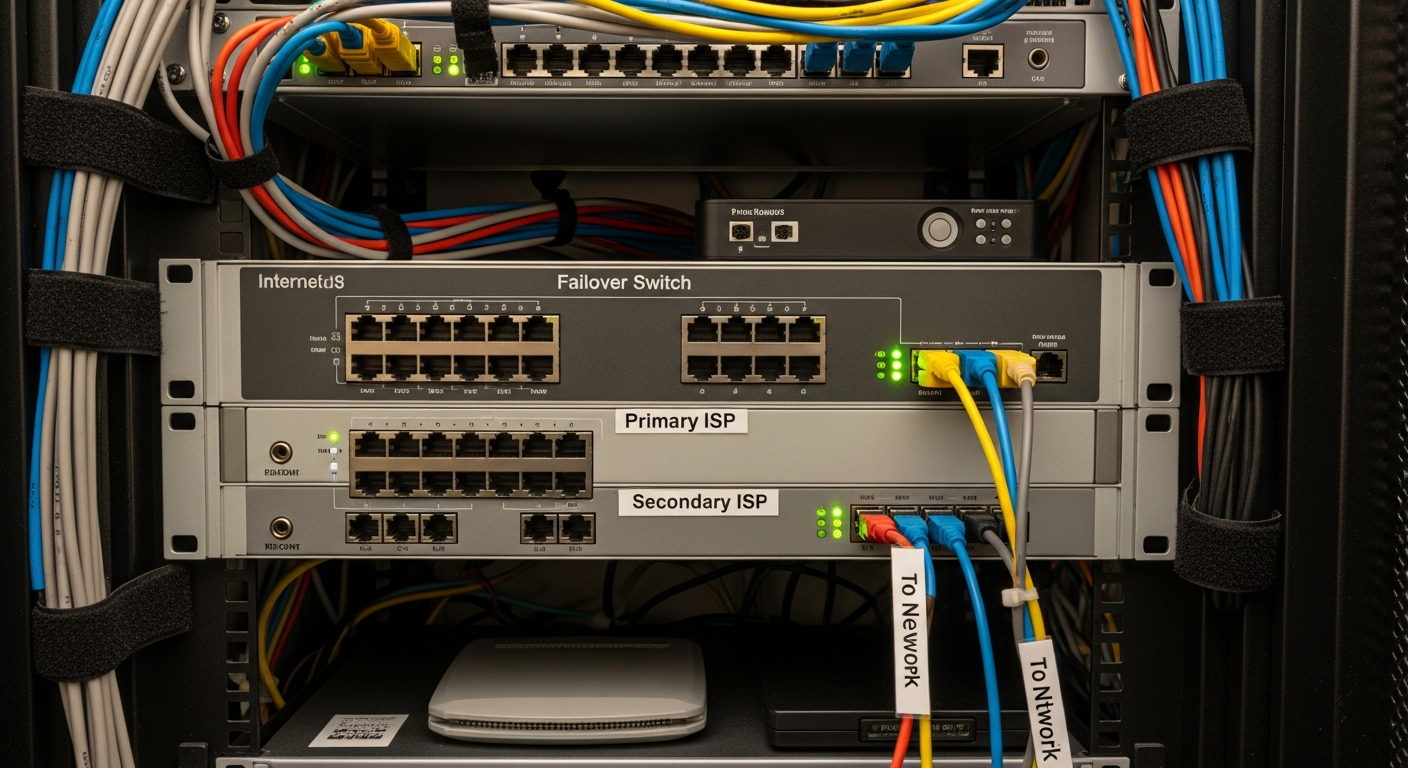
A backup line that someone has to walk into a closet and switch over is barely a backup. By the time anyone notices the outage, finds the right cable, and reconnects, you have lost an hour. SD-WAN changes this. It sits over your circuits, watches each one for packet loss and latency, and shifts traffic to the healthy link automatically. A good deployment fails over in seconds, and for many workloads the call or the session keeps running without a drop.
SD-WAN also lets you use both circuits at once rather than parking the second one idle. You can send your phone traffic down the most stable path while bulk file transfers take the other, then collapse everything onto whichever link survives. You stop paying for a backup that does nothing on a normal day.
We used to lose half a day every time a line dropped. After we moved to two diverse carriers with automatic failover, our last three outages were total non events. Most of the staff never even knew a circuit had gone down.
— Operations Manager, multi-branch credit union
Size It to What Downtime Actually Costs
Not every location needs the same protection, and that is fine. The honest question is what one hour of downtime costs at a given site. For a back office that mostly does email, a cellular backup that kicks in for the rare outage is plenty. For a call center, a clinic, or a warehouse where every minute of dead network stops revenue, full diverse fiber with sub second failover earns its keep.
Run the rough math. If an hour offline costs your busiest location 5,000 dollars in lost orders and idle staff, and a redundant setup adds a few hundred dollars a month, the second outage alone pays for years of protection. Most businesses underestimate this number until they have eaten one bad day. Then it becomes very easy to justify.
Do Not Forget the Equipment and the Power
Circuit diversity is the headline, but the gear matters too. If both circuits plug into one router and that router dies, you are down regardless. Redundant hardware and battery backup for the network closet protect against the failures that have nothing to do with your carrier. A surprising number of outages are simply a power blip that rebooted equipment without a clean recovery.
If you are not certain whether your current setup would actually survive a cut line, that is worth checking before the cut happens. We map your circuits across locations, confirm whether they are genuinely diverse, and price failover options from multiple carriers so the backup is on a different network than the primary. The point is simple. When the next Tuesday outage comes, and it will, the only people who notice should be the ones reading about it later in a report.
Upgrade Your Team's Connectivity
Whether your team works from the office, home, or on the road, the right communications setup makes all the difference. Let us design a solution that keeps everyone connected and productive.